Rediscovering our history with the land, settlements, and how we moved from place to place.
A Ride on the Coopersville & Marne Railway
Get link
Facebook
X
Pinterest
Email
Other Apps
In our previous blog, I discussed our trip to Western Michigan, and the railroad history I discovered during our visit. I chose to split the trip into two blogs due to its length, and secondly, because the Coopersville & Marne Railway is alive and well, having preserved a section of the old Grand Trunk Western route between its namesake towns.
We visited on Memorial Day before heading home, and in a nice touch, all veterans, uniformed or not, were granted free passage on the train.
The first thing I noticed upon driving up to the Coopersville station wasn't the train itself, but rather, a big, beautiful, but rusting steam engine on the opposite side of the platform, which I learned was once Canadian National 1395.
CN 1395, one of a few pieces of rolling stock on C&M property. Not used, nor are there any current restoration plans.
Here's a postcard of what it looked like in its heyday.
There were a few other pieces of rolling stock that weren't in operable condition either.
An ex-C&O caboose is also among the rolling stock in the yard.
I can honestly say I'd never heard of the Cornpike Express before.
As I had a little time to kill before departure, we walked up the street to the Coopersville Historical Museum, which I talked a little about in the last blog. Located in what was once an interurban depot, they have a GRGH&M car on display, as well as a neat little crossbuck.
I can honestly say I'd love to have something like this in my backyard. I wonder how old it is.
According to their website, the Coopersville & Marne Railway began in 1989. The line was chartered in 1848 as the Oakland and Ottawa Railroad Company. By 1858, operations had begun, but not before the name was changed to the Detroit and Milwaukee Railroad. As many railroads changed hands early in their life, the D&M was no exception, becoming the Detroit, Grand Haven and Milwaukee Railway under the financial control of the Great Western Railway (the Canadian company, not to be confused with its British counterpart). In 1928, it finally became part of Grand Trunk Western, which itself was CN's American subsidiary at the time.
The line was to be abandoned, before being purchased by the Central Michigan Railway, a short-line, in 1987. CMR then sold the line to the C&M, and operations began one year after their purchase, in 1990.
Which brings us to today, or more specifically, Memorial Day. The train consist was C&M 7014, two cars and a caboose. According to the C&M website, "Our train is usually pulled by a 1950's era,125 ton General Motors SW9 switcher locomotive, #7014. This locomotive had been owned by the Grand Trunk Western Railway and served in Battle Creek, Michigan. The 1200 horsepower diesel engine turns a generator, which feeds electricity to the traction motors, which are geared to driving wheels. As much as possible, we stress vintage operation of the equipment, including proper dress for members of the train crew."
We sat in the second car.
C&M 7014 was our power for the day.
The train departed a few minutes late as they waited for a few late showing guests. Once operations got underway, even though it wasn't a particularly warm day, I immediately felt gratitude for living in a time of air conditioning. The old coaches warm up fast! Thankfully, the windows were opened, allowing for a fantastic breeze as we slowly made our way through the countryside.
This friendly conductor (I believe his name was Tom Anderson) checked tickets and discussed a little of the history behind the line during the trip.
The conductor explained that the C&M is an all-volunteer heritage line, with the engineer, brakeman and conductor being able to run one train. This train had a brakeman trainee as well, as well as two volunteers dispensing (free!) refreshments aboard the train, which I thought was a fantastic touch.
CMRY 75009, the operating caboose.
Once the train pulled into Marne, we could get out and watch 7014 make the turnabout trip to connect to the caboose. Unlike at the Illinois Railway Museum, they uncouple the engine, allowing the engineer to see out front, without the need for control from the caboose. I made a video of the operation taking place:
Throughout the trip, you can see a bit of transportation history on either side of the tracks. Looking south, you'll see I-96 in spots, as the interstate was built to follow the trackage itself.
I-96 crosses over a road, which also goes under the C&M right of way.
Look north, and you can see electrical poles, which are the only remnant of the parallel Grand Rapids, Grand Haven & Muskegon Electric Railway left along the route.
As you may have guessed with all the growth here, there's plenty of deer and other wildlife nearby.
Look to the ground, and you can occasionally see water, being the oldest transportation route along this corridor. According to the C&M website, "the track follows an ancient water route first cut into the earth by glacial events." making that the oldest route by thousands of years!
One interesting thing about the C&M is that they also have a freight operation east of Marne, continuing into Grand Rapids. West of Coopersville, however, the line is abandoned into Spring Lake, MI, immediately north of Grand Haven, where it once connected to the Pere Marquette Railway, later becoming part of the Chesapeake & Ohio.
The entire trip took about 90 minutes, after which we headed home for the weekend. I hope one day that the C&M expands their station a little in Coopersville. It would've been nice to pick something up from their non-existent gift shop. A bigger pipe dream would be for them to restore CN 1395 into service, but I understand restoring a locomotive takes more than just throwing money at it.
That being said, the trip was more than enjoyable, the staff was friendly, and everyone seemed to enjoy themselves, except for the screaming babies. I learned a lot and definitely recommend the trip if you happen to find yourself in southwest Michigan.
Thanks to the C&M for the experience, and thanks a lot to you for reading!
Across the rolling hills and rugged landscapes of western Ireland, one can find peculiar relics of a dark chapter in the island’s history. These are the Famine Roads - routes that climb into the hills, twist through valleys, and often end abruptly, leading nowhere. Their haunting presence is a testament to the desperation and suffering endured by countless Irish peasants during the Great Famine of 1845–1852. "One of the many roads to nowhere built during the Famine" (Image via sboins on Reddit ) The Great Famine , or Án Gorta Mór, was a catastrophic period in Ireland’s history, marked by mass starvation, disease, and emigration. Over one million people perished, and another two million fled the country, profoundly altering Ireland’s demographic and cultural landscape. In an era dominated by the rigid doctrines of laissez-faire economics, relief efforts were minimal, and assistance often came with cruel conditions. Under the Poor Law and its amendments, relief programs were es...
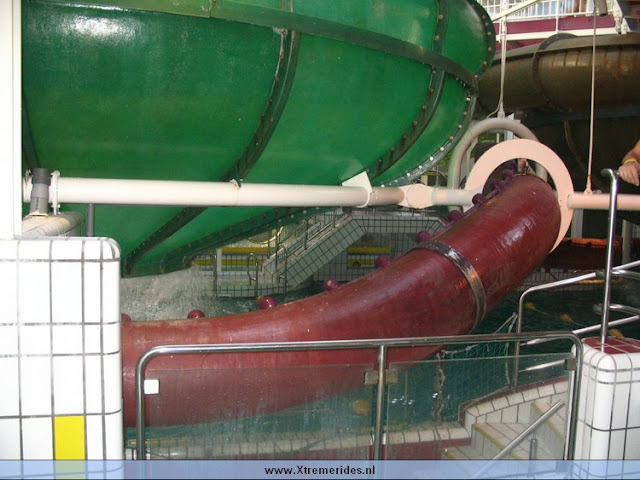
Have you ever wished to experience being transferred from one pool of liquid to another via a pipe? Had you visited the Dutch water park known as Durinrell , also known as Tikibad before 2010, you would have had the chance. Half water slide, half war crime, this was a unique water slide that was filled to the brim with water, leaving riders completely submerged throughout the journey. Image: XtremeRidesNL Known as the Fly Over was an underwater water slide, which is exactly how it sounds, and transported riders from one pool to another using the water as propulsion. Built in 1994, riders dove underwater to access the slide, using gravity to transport them upwards via the Communicating Vessels Principle . Riders would be completely underwater for about 15-20 seconds. This is how I imagine those 15-20 seconds felt like while riding the slide. The slide was built to drain water in five seconds or less in case a rider got stuck in the slide or had a medical emergency, but the threat...
Centralia, Pennsylvania is one of those places where the popular story can easily become more interesting than the history itself, as evidenced by its plight being the basis for the first Silent Hill movie, in an attempt to explain the area fog, more famously a motif of the video game series. Image of Locust Av in Centralia, PA, c. 1960. Unknown photographer, local archives. A town catches fire beneath the ground, a highway buckles and cracks, most of the residents leave, and a handful of people remain. The result is usually described as a ghost town. While Centralia is the most famous example, underground coal fires are not uncommon across the world. The Jharia Coal Field in India, for example, has been burning for over 100 years . Centralia, PA on the Ashland USGS 1947 Topo Map with various Lehigh Valley Railroad lines. PA 61 is labeled as US 122 , which was an intrastate US Highway until 1963. But Centralia was not simply abandoned overnight, and the fire was not a...



Comments
Post a Comment