Rediscovering our history with the land, settlements, and how we moved from place to place.
The Illinois Railway Museum in Union, IL
Get link
Facebook
X
Pinterest
Email
Other Apps
The Illinois Railway Museum is one of the largest railroad museums in the US, located in Union, IL. It has active rolling stock along what used to be the right of way of the Elgin & Belvidere Electric Railway, having been in its current location since the early 1960's.
IRM 1630 - An ex-Frisco steam engine, running during my 2014 visit.
According to its website, "the mission of the Illinois Railway Museum is to educate the public as to our nation’s railroad and railway history by collecting, preserving, and restoring rolling stock, artifacts, structures, and related transportation equipment for display to the public; exhibiting and operating restored rolling stock and equipment on a demonstration rail line; and collecting, preserving, and maintaining a reference library of publications, technical information, and other materials regarding railroads, railways, and related forms of transportation for research and other purposes."
The museum has dozens of engines, many restored, some soon to be restored.
In its infancy in the 1950's, the Railway Museum was located along the former right of way of the Chicago North Shore & Milwaukee, another interurban railway, in North Chicago, IL.
The museum's history is noted on this sign along what was once the entrance to the museum.
As one might guess from the fact that it's been located along two abandoned interurban rights of way, the museum tries to keep the history of Chicago's interurban network alive, and puts a major focus on these
passenger operations, as well as the CTA and former city trolley/electric lines.
This is the oldest surviving piece in IRM's collection; a relic of horse-drawn trolley cars from Chicago's earliest street railroad.
I'd visited the railway museum twice before 2019; once in 2014 and again in 2017. One thing that's always struck me about the museum is that each time I've visited, I've learned something new, or seen things in a different light than I had previously. My first visit, I was most interested in the steam engines. My second, I was looking for historical documents, maps, and books for sale (something the IRM has improved on with their new gift shop)., and this last time, I spent much of my time looking at the interurban cars. With that in mind, I figured I'd share my photos of my visits.
IRM 1630 lets off steam as it backs onto the mainline of the Illinois Railway Museum. Obviously, it's an ex-Frisco locomotive.
My most recent visit was on a day that was supposed to be sunny and warm, but it wound up storming through a majority of my visit. I didn't stay long, and all of the rolling stock managed to remain operational.
One of the operational diesel engines running during 2017.
A US Army Transportation Corps switcher on display each of my visits.
The trolley is a fully restored remnant from Chicago Surface Lines, saved only after it was converted into a storage shed, as all other trolleys of its type were scrapped. The restoration also includes ads from the days of when they trolley was in service. This helps to capture what a typical day was like riding those trolleys.
There are nine barns for displays; three of which are devoted to interurban rolling stock. Trolley trips do a circle around the museum, allowing you to see some of the areas of engines yet to be restored as well. The steam and diesel engines runs for about 4 miles south along the aforementioned Elgin & Belvidere Electric Railway ROW.
The exterior of the in-service trolley.
There are all sorts of pieces of rolling stock, many of which would be difficult to spot were they not preserved here.
One thing I wish the museum had was more maps and books. But that's the history buff in me talking.
Leaving the IRM in 2017, I managed to catch the tail end of a diesel run.
Ultimately, there are enough static displays and train rides to keep the family of all ages occupied for an entire day, even in the rain, and plenty of railroad history to be learned, with many volunteers willing to discuss things further if you ask. I didn't picture everything, and like many things, visiting them in person will leave much more of an impression than seeing pictures and videos.
US Navy Steam Locomotive, one of the displays in the steam barn.
In addition to being huge, these wheels, and the tires on them, make for some interesting YouTube videos. FIRE!
A boxcar which appeared to be undergoing restoration on the tracks north of the steam barn.
Unfortunately, this beauty wasn't in action on our most recent visit.
A functioning wig-wag crossing, one of several at the museum.
It appears the museum is undergoing further expansion as of our last visit. I wonder what's coming!
The museum is well worth the drive to Union, and hopefully it's an enjoyable visit you learn a thing or two from.
Across the rolling hills and rugged landscapes of western Ireland, one can find peculiar relics of a dark chapter in the island’s history. These are the Famine Roads - routes that climb into the hills, twist through valleys, and often end abruptly, leading nowhere. Their haunting presence is a testament to the desperation and suffering endured by countless Irish peasants during the Great Famine of 1845–1852. "One of the many roads to nowhere built during the Famine" (Image via sboins on Reddit ) The Great Famine , or Án Gorta Mór, was a catastrophic period in Ireland’s history, marked by mass starvation, disease, and emigration. Over one million people perished, and another two million fled the country, profoundly altering Ireland’s demographic and cultural landscape. In an era dominated by the rigid doctrines of laissez-faire economics, relief efforts were minimal, and assistance often came with cruel conditions. Under the Poor Law and its amendments, relief programs were es...
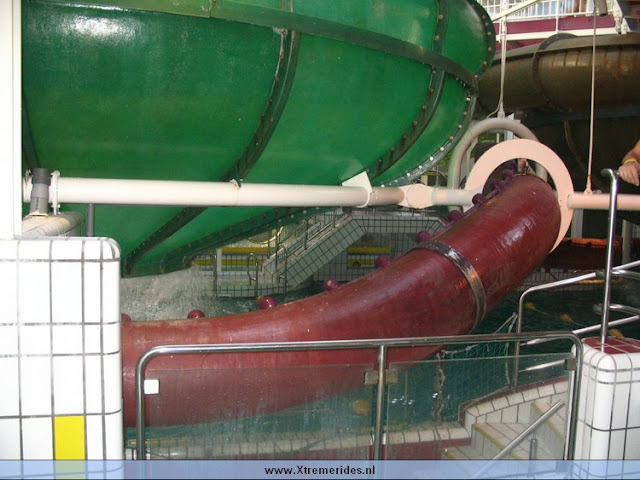
Have you ever wished to experience being transferred from one pool of liquid to another via a pipe? Had you visited the Dutch water park known as Durinrell , also known as Tikibad before 2010, you would have had the chance. Half water slide, half war crime, this was a unique water slide that was filled to the brim with water, leaving riders completely submerged throughout the journey. Image: XtremeRidesNL Known as the Fly Over was an underwater water slide, which is exactly how it sounds, and transported riders from one pool to another using the water as propulsion. Built in 1994, riders dove underwater to access the slide, using gravity to transport them upwards via the Communicating Vessels Principle . Riders would be completely underwater for about 15-20 seconds. This is how I imagine those 15-20 seconds felt like while riding the slide. The slide was built to drain water in five seconds or less in case a rider got stuck in the slide or had a medical emergency, but the threat...
Centralia, Pennsylvania is one of those places where the popular story can easily become more interesting than the history itself, as evidenced by its plight being the basis for the first Silent Hill movie, in an attempt to explain the area fog, more famously a motif of the video game series. Image of Locust Av in Centralia, PA, c. 1960. Unknown photographer, local archives. A town catches fire beneath the ground, a highway buckles and cracks, most of the residents leave, and a handful of people remain. The result is usually described as a ghost town. While Centralia is the most famous example, underground coal fires are not uncommon across the world. The Jharia Coal Field in India, for example, has been burning for over 100 years . Centralia, PA on the Ashland USGS 1947 Topo Map with various Lehigh Valley Railroad lines. PA 61 is labeled as US 122 , which was an intrastate US Highway until 1963. But Centralia was not simply abandoned overnight, and the fire was not a...




Comments
Post a Comment